
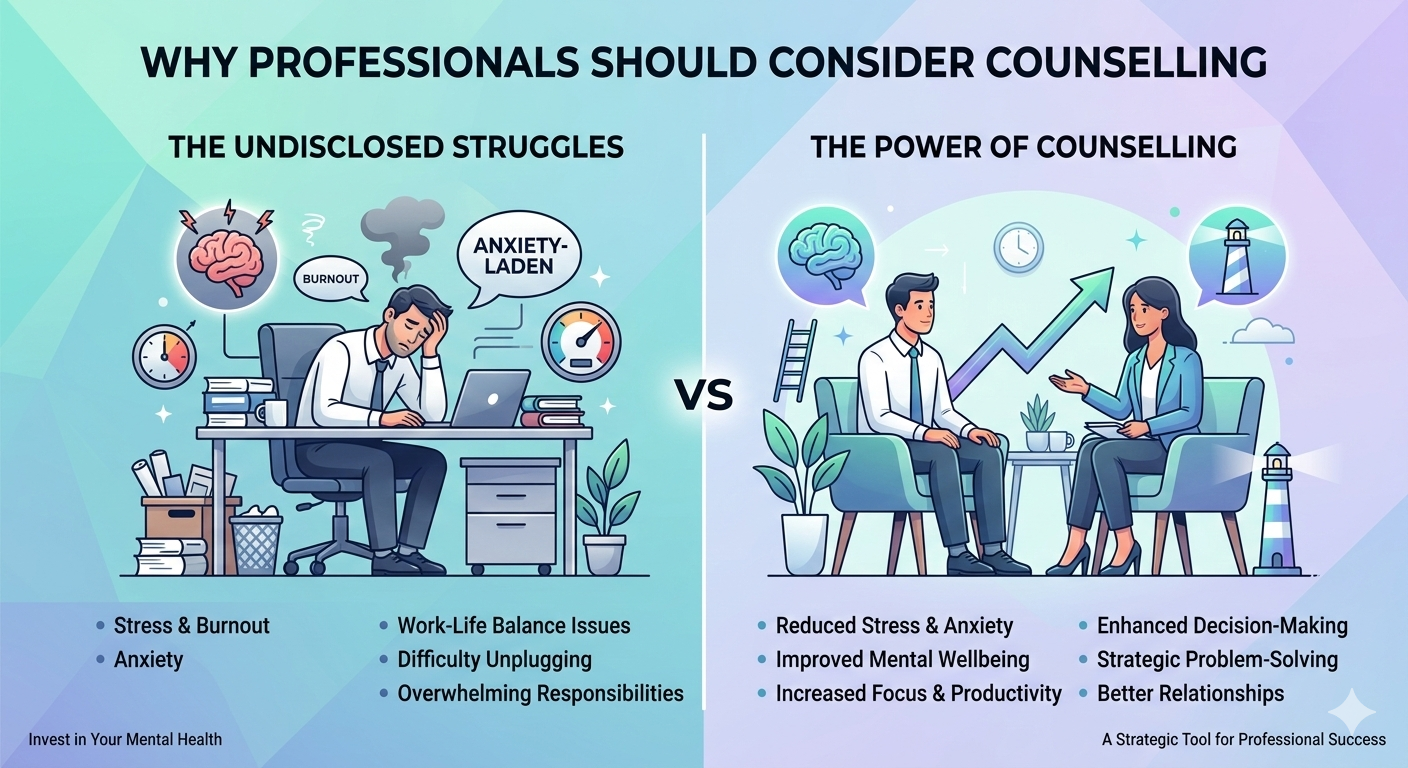
In today’s rapidly evolving professional landscape, success is no longer defined only by qualifications, experience, or income. Professionals are expected to constantly upgrade their skills, make strategic career decisions, maintain relationships, and manage emotional well-being simultaneously. The pressure to balance professional growth with personal stability often becomes overwhelming.
Many professionals try to solve these challenges alone. However, the complexity of modern life means that informed guidance can make a significant difference. Counselling provides a structured and thoughtful approach to decision-making, emotional clarity, and long-term planning.
Professional counselling is not only about dealing with crises. It is a proactive step that helps individuals make better choices, avoid costly mistakes, and build a more fulfilling personal and professional life. Whether someone is navigating career transitions, choosing educational pathways, managing relationships, planning marriage, or dealing with emotional stress, counselling offers clarity and direction.
This article explores why professionals should consider counselling and how it can support them in five critical areas: career guidance, admission guidance, relationship guidance, marriage guidance, and personalized emotional support.
1. Career Guidance: Making Strategic Professional Decisions
One of the biggest challenges professionals face today is career uncertainty. Unlike earlier generations, where career paths were relatively linear, modern careers are dynamic and constantly evolving. New industries emerge, skill requirements change, and professionals frequently consider career shifts or higher education to stay relevant.
Many professionals reach a stage where they begin asking important questions:
- Should I switch industries?
- Is it the right time to pursue higher education?
- Should I move into management or specialize further?
- Is my current career aligned with my long-term goals?
Without proper guidance, these decisions can be confusing and risky. Career counselling helps professionals evaluate their strengths, interests, market opportunities, and long-term aspirations.
A counsellor can help professionals:
- Assess their current career trajectory
- Identify skill gaps and growth opportunities
- Explore new career options or industry transitions
- Develop a structured career development plan
For example, a working professional in the IT industry may feel stuck in a technical role but aspire to move into management. Career counselling can help them understand whether pursuing an MBA, certifications, or leadership training would support their transition.
Similarly, professionals considering entrepreneurship may need guidance on the risks, preparation, and timing of such a move.
Career counselling helps professionals make informed decisions rather than impulsive ones. It ensures that career choices are aligned with both personal ambitions and market realities.
2. Admission Guidance: Choosing the Right Educational Path
Many professionals reach a point in their careers where higher education becomes necessary for advancement. Programs such as online MBA, executive MBA, specialized certifications, or postgraduate degrees often become important stepping stones.
However, choosing the right university, course, and mode of learning can be overwhelming. There are hundreds of institutions offering similar programs, each with different fee structures, curriculum designs, accreditation standards, and career outcomes.
Professionals often struggle with questions like:
- Which university has better credibility?
- Should I choose an online program or a hybrid one?
- Is the curriculum relevant to industry needs?
- Will the degree actually improve my career prospects?
Admission counselling helps professionals navigate these decisions carefully.
A good admission counsellor evaluates multiple factors before suggesting the right program, such as:
- Career objectives of the professional
- Work experience and academic background
- Budget and time commitment
- Reputation and credibility of institutions
- Course content and faculty expertise
For instance, a mid-career professional looking for leadership roles may benefit more from a management-focused MBA, while someone in a technical field might require specialized certifications instead.
Admission guidance also helps professionals avoid common pitfalls, such as enrolling in low-quality institutions, choosing courses with outdated curriculum, or committing to programs that demand unrealistic time commitments.
By selecting the right educational path, professionals can significantly improve their career trajectory while balancing work and study effectively.
3. Relationship Guidance: Navigating Complex Personal Dynamics
Professional life often demands long working hours, frequent travel, and constant mental engagement. While individuals focus on career growth, relationships sometimes receive less attention.
However, healthy relationships are essential for emotional stability and overall life satisfaction. Professionals frequently experience challenges in relationships due to:
- Lack of communication
- Work-life imbalance
- Emotional distance
- Misaligned expectations
These challenges may arise in romantic relationships, live-in partnerships, dating relationships, or even close friendships.
Relationship counselling helps individuals understand relationship dynamics more clearly. Instead of reacting emotionally to conflicts, professionals learn to communicate better, manage expectations, and build stronger connections.
For example, professionals in demanding jobs may unknowingly neglect emotional needs within their relationships. Counselling helps them recognize these patterns and develop healthier communication habits.
Relationship guidance also helps individuals:
- Understand compatibility and long-term expectations
- Identify unhealthy relationship patterns
- Improve emotional communication
- Resolve conflicts constructively
In many cases, professionals struggle silently with relationship stress while maintaining a composed appearance at work. Counselling provides a safe and confidential environment where individuals can openly discuss their concerns.
When relationships become healthier and more stable, professionals often experience improved focus, confidence, and emotional well-being.
4. Marriage Guidance: Preparing for One of Life’s Major Decisions
Marriage remains one of the most significant personal decisions in a person’s life. However, the social landscape around marriage has become increasingly complex.
Professionals today consider many factors before committing to marriage, such as career compatibility, financial planning, lifestyle preferences, and long-term personal goals.
Unlike earlier generations, where marriage decisions were often family-driven, modern professionals take a more thoughtful and independent approach.
Marriage counselling helps individuals reflect on important questions such as:
- Are both partners aligned in terms of career priorities?
- How will professional ambitions affect family life?
- Are expectations regarding finances, lifestyle, and responsibilities clearly understood?
- Is the relationship emotionally stable enough for marriage?
Pre-marriage counselling helps couples develop realistic expectations and better communication before entering married life.
For professionals, marriage often intersects with career decisions. For instance:
- Relocation for job opportunities
- Work-life balance considerations
- Financial planning and long-term goals
Counselling helps individuals and couples discuss these aspects openly before making commitments.
Marriage guidance is not about questioning the relationship but about strengthening it with clarity and mutual understanding.
When professionals enter marriage with better preparation and communication skills, they are more likely to build stable and supportive partnerships.
5. Personalized Emotional Support: Managing Stress and Mental Pressure
Behind professional success often lies significant emotional pressure. Deadlines, workplace competition, financial responsibilities, and personal expectations can gradually build emotional fatigue.
Many professionals experience:
- Workplace burnout
- Persistent stress and anxiety
- Emotional exhaustion
- Feelings of loneliness or isolation
Because professionals are often expected to appear confident and composed, they rarely express these struggles openly.
Personalized counselling provides a confidential space where individuals can express their thoughts and emotions without judgment.
Unlike casual advice from friends or colleagues, professional counselling focuses on structured understanding of emotional challenges.
A counsellor helps professionals:
- Identify the root causes of stress
- Develop coping strategies
- Improve emotional resilience
- Maintain mental clarity in high-pressure environments
Personalized emotional support is particularly valuable during major life transitions such as job changes, relocations, career uncertainty, or personal relationship changes.
Professionals who invest in their emotional well-being often perform better in their careers because they are mentally balanced and emotionally aware.
Counselling is therefore not a sign of weakness but a tool for personal growth and emotional strength.
Conclusion
The modern professional environment demands constant adaptation, thoughtful decision-making, and emotional resilience. Career transitions, educational choices, relationship dynamics, and personal well-being are all interconnected aspects of life that influence professional success.
Counselling offers professionals a structured and supportive framework to navigate these challenges. Through career guidance, individuals can make informed professional decisions. Admission guidance helps them select the right educational opportunities. Relationship and marriage guidance strengthen personal connections, while personalized emotional support ensures mental well-being.
In a world where professionals are expected to manage multiple responsibilities simultaneously, seeking guidance is not a sign of uncertainty—it is a strategic step toward clarity and growth.
Ultimately, counselling empowers professionals to make thoughtful choices, maintain emotional balance, and build a life that is both successful and fulfilling.

Reply here