
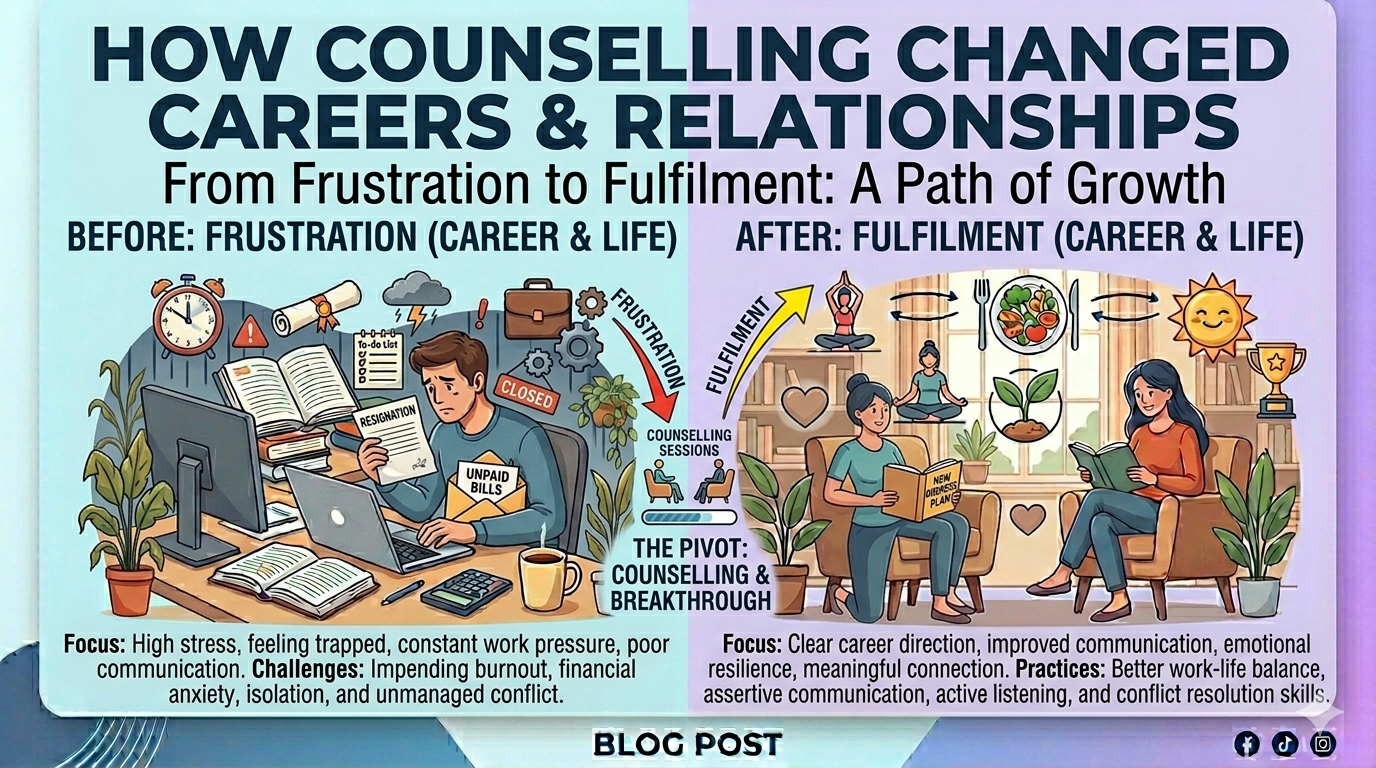
In today’s fast-paced and highly competitive world, individuals often find themselves overwhelmed—whether it’s choosing the right career path or navigating complex relationships. This is where counselling plays a transformative role. Through structured guidance, emotional support, and expert insights, counselling helps people make informed decisions, heal emotional wounds, and build fulfilling lives.
With the rise of e-counselling and tele-counselling, access to professional help has become easier than ever, especially in India where social stigma around seeking help is gradually fading. A well-conducted counselling session with an experienced expert or life coach can bring clarity, confidence, and direction.
In this blog, we explore 10 real-life inspired case studies from Indian society—five focused on career transformation and five on relationship improvement—to understand how counselling truly changes lives.
Part 1: Career Transformation Through Counselling
Case Study 1: The Engineering Trap
Background:
Rohit, a 22-year-old from Kota, pursued engineering due to family pressure. Despite completing his degree, he felt disconnected and unmotivated.
Challenge:
Lack of interest in his field led to anxiety and poor job performance.
Counselling Intervention:
During multiple counselling sessions, a career expert identified Rohit’s inclination toward creative writing and media. Through e-counselling, he explored career options beyond traditional paths.
Outcome:
Rohit transitioned into content creation and now works with a digital marketing firm. His productivity and confidence improved drastically.
Key Insight:
Counselling helps break societal expectations and align careers with passion.
Case Study 2: The Confused Commerce Student
Background:
Neha, a Class 12 student from Delhi, was confused between CA, BBA, and psychology.
Challenge:
Information overload and peer pressure created indecision.
Counselling Intervention:
A structured tele-counselling approach helped her assess aptitude, personality, and long-term goals.
Outcome:
She chose psychology and is now pursuing a master’s degree, aspiring to become a life coach.
Key Insight:
Early counselling ensures informed decision-making and avoids future regret.
Case Study 3: Mid-Career Burnout in IT
Background:
Amit, 35, worked in IT for over a decade in Bengaluru.
Challenge:
Severe burnout, dissatisfaction, and lack of work-life balance.
Counselling Intervention:
Through weekly e-counselling sessions, an expert helped him identify stress triggers and rediscover his interest in teaching.
Outcome:
Amit shifted to corporate training and now conducts workshops, earning both satisfaction and stability.
Key Insight:
Career change is possible at any stage with the right guidance.
Case Study 4: The UPSC Aspirant Loop
Background:
Pooja spent 5 years preparing for UPSC in Delhi.
Challenge:
Repeated failures led to self-doubt and depression.
Counselling Intervention:
A life coach conducted structured counselling sessions focusing on emotional resilience and alternative career planning.
Outcome:
She pivoted to public policy and now works with an NGO.
Key Insight:
Counselling helps redefine success beyond a single goal.
Case Study 5: The Family Business Dilemma
Background:
Arjun from Jaipur was expected to join his family business.
Challenge:
He wanted to pursue entrepreneurship in tech instead.
Counselling Intervention:
Through tele-counselling, an expert mediated between Arjun and his family, addressing concerns and expectations.
Outcome:
Arjun launched his startup with partial family support.
Key Insight:
Counselling bridges generational gaps and supports independent choices.
Part 2: Relationship Transformation Through Counselling
Case Study 6: Pre-Marital Conflicts
Background:
Riya and Karan, an urban couple from Mumbai, faced compatibility issues before marriage.
Challenge:
Frequent arguments over career priorities and family expectations.
Counselling Intervention:
Pre-marital counselling sessions helped them understand communication styles and conflict resolution.
Outcome:
They developed mutual respect and entered marriage with clarity.
Key Insight:
Counselling prevents future conflicts by addressing issues early.
Case Study 7: Long-Distance Relationship Strain
Background:
Sneha and Rahul were in a long-distance relationship between India and Canada.
Challenge:
Trust issues and communication gaps.
Counselling Intervention:
Regular e-counselling sessions helped them establish communication routines and emotional transparency.
Outcome:
Their relationship strengthened, and they eventually reunited.
Key Insight:
Structured guidance enhances trust and emotional connection.
Case Study 8: Marital Breakdown After 10 Years
Background:
A couple from Pune faced emotional disconnect after a decade of marriage.
Challenge:
Lack of communication and growing resentment.
Counselling Intervention:
A relationship expert conducted tele-counselling, focusing on empathy, listening skills, and rebuilding trust.
Outcome:
They rekindled their bond and avoided separation.
Key Insight:
Even long-term relationships can heal with professional help.
Case Study 9: Parent-Child Conflict
Background:
A 16-year-old boy from Lucknow frequently clashed with his parents over academic pressure.
Challenge:
Communication breakdown and emotional distress.
Counselling Intervention:
Family counselling sessions helped both sides understand each other’s perspectives.
Outcome:
Parents adopted a supportive approach, and the child showed improved performance and mental well-being.
Key Insight:
Counselling strengthens family dynamics and mutual understanding.
Case Study 10: Recovering from a Toxic Relationship
Background:
Anjali from Hyderabad struggled to move on from a toxic relationship.
Challenge:
Low self-esteem and emotional dependency.
Counselling Intervention:
Through consistent e-counselling, a life coach worked on self-worth, boundaries, and healing.
Outcome:
Anjali regained confidence and built healthier relationships.
Key Insight:
Counselling empowers individuals to rebuild themselves emotionally.
Why Counselling Works: Key Takeaways
Across these case studies, certain patterns emerge that explain why counselling is so effective:
1. Personalized Guidance
Every individual receives tailored advice based on their unique situation during a counselling session.
2. Emotional Support
An expert provides a safe, non-judgmental space to express thoughts and feelings.
3. Clarity and Direction
Counselling helps individuals identify goals and actionable steps.
4. Accessibility Through Technology
With e-counselling and tele-counselling, professional help is available anytime, anywhere.
5. Long-Term Impact
The skills learned—communication, decision-making, emotional intelligence—benefit individuals throughout life.
The Growing Importance of Counselling in India
In Indian society, counselling was once considered taboo. However, increasing awareness, changing lifestyles, and rising stress levels have made it essential. Students, professionals, couples, and families are now actively seeking help from life coaches and mental health experts.
Digital platforms offering e-counselling and tele-counselling have further democratized access, especially in Tier 2 and Tier 3 cities. This shift indicates a positive change toward prioritizing mental and emotional well-being.
Conclusion
The stories shared above highlight a powerful truth—counselling has the potential to transform lives. Whether it’s choosing the right career, overcoming failures, or rebuilding relationships, a single counselling session can be the first step toward meaningful change.
With the support of a skilled expert or life coach, individuals can navigate life’s uncertainties with confidence and clarity. As India continues to evolve, embracing counselling—through both traditional and digital means like e-counselling and tele-counselling—will play a crucial role in shaping healthier, happier, and more fulfilled lives.
If you’re feeling stuck in your career or struggling in your relationships, remember—seeking help is not a weakness; it’s a step toward transformation.
Reply here