
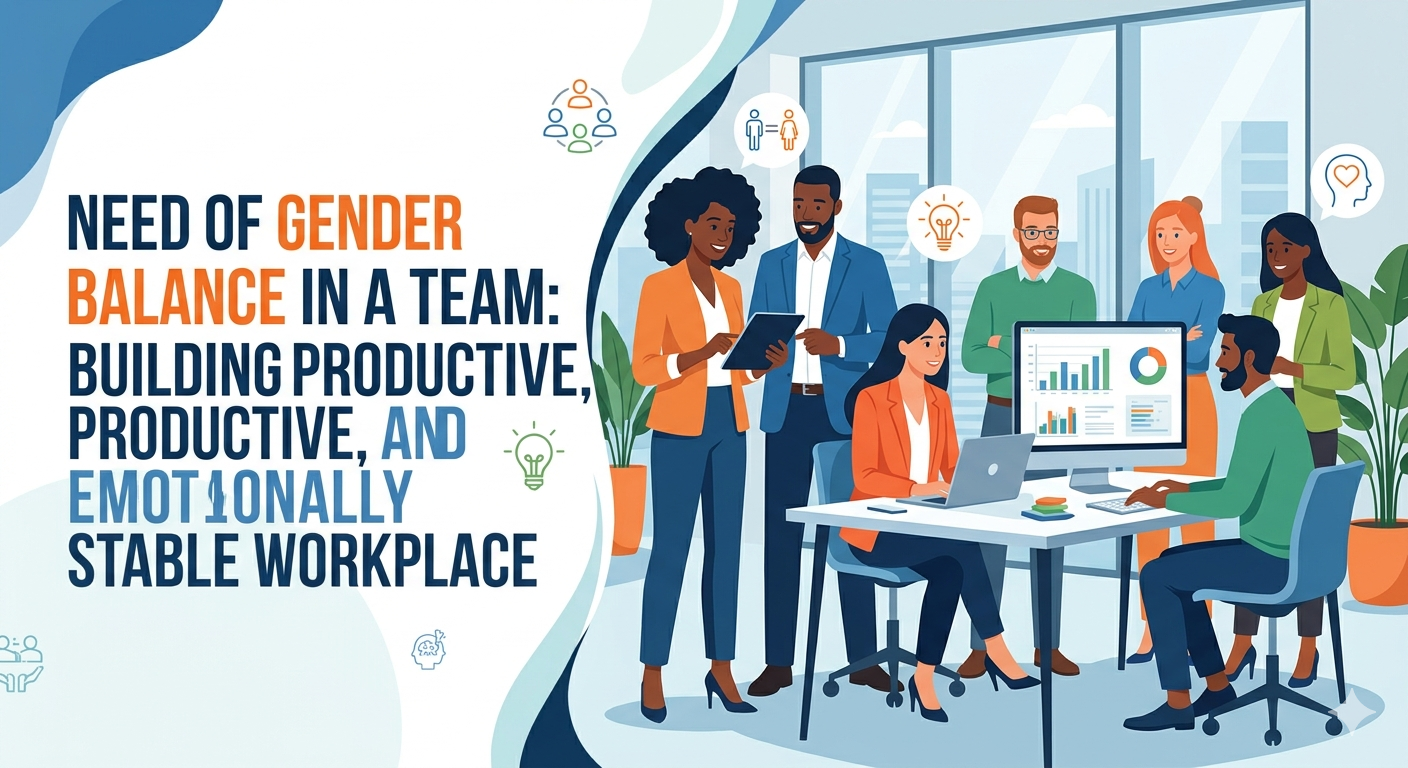
Modern workplaces are no longer just about deadlines, presentations, and performance reviews. Offices have become social ecosystems where employees spend nearly 8 to 10 hours every day. In such an environment, gender balance is not merely a diversity metric—it is a practical necessity for emotional well-being, workplace harmony, productivity, and organizational growth.
Today, companies across industries are focusing on balanced teams because they understand that workplace culture directly impacts employee motivation, creativity, mental health, and retention. A team that includes both men and women often creates healthier communication patterns, reduces toxic behavior, and develops a more emotionally aware work culture.
Why the Corporate World Focuses on Gender Balance
Gender diversity introduces varied communication styles, problem-solving approaches, emotional intelligence, and social awareness.
For decades, workplaces were dominated by male-centric structures. This often created rigid environments where emotional expression, empathy, and collaborative communication were undervalued. Research across industries consistently shows that gender-diverse teams are more innovative and better at decision-making because they avoid “groupthink.” When teams include both men and women, discussions become more balanced, customer understanding improves, and workplace behavior becomes more accountable.
Real-Life Example
A multinational IT company noticed that its customer support division had higher employee turnover and internal conflicts in all-male teams. After restructuring teams to include more women professionals, communication improved significantly. Employees reported fewer aggressive interactions, and client satisfaction scores increased because the conversations became more empathetic and solution-oriented. influences workplace performance and behavior.
Why Aim for 33% Women Hiring
When women are present in very small numbers, they may feel isolated, unheard, or pressured to adjust to dominant workplace cultures. However, when a substantial percentage of women exist within a team, workplace interactions naturally become more balanced and respectful.
Real-Life Example
In a consulting firm, women employees initially made up only 10% of the workforce. Female staff frequently avoided late meetings and informal team interactions because they felt uncomfortable in male-dominated spaces. After increasing women participation to nearly one-third of the team, employee engagement improved, and more women took leadership roles confidently.
The change happened because people no longer felt like “outsiders” in the workplace. A balanced team also encourages women employees to remain in the workforce for longer durations, especially after marriage or parenthood.
Gender Balance Reduces Sexism and Abusive Work Environments
One of the biggest advantages of gender-balanced teams is the reduction of toxic workplace behavior.
In highly imbalanced environments, sexist jokes, verbal aggression, insensitive comments, and unhealthy competitions are normalized. Employees may hesitate to report inappropriate behavior because they fear isolation or retaliation.
Gender-balanced teams create social accountability. People become more conscious of their language, attitude, and behavior. Mutual respect increases because employees interact regularly with colleagues from different genders.
Women employees often bring emotional awareness and collaborative communication styles that help soften harsh workplace dynamics.
Real-Life Example
An advertising agency struggled with late-night office culture where abusive language and unhealthy sarcasm were common. HR intervention introduced gender-diverse hiring and stricter inclusivity measures. Over time, employees reported a more respectful environment. Even male employees admitted that meetings became calmer and more constructive.
This shows how gender balance can influence behavioral standards without reducing productivity.
Role of Gender Balance in Office Romance and Human Connection
Office romance remains a sensitive topic, but it is also a reality of modern professional life. Employees spend a significant portion of their lives at work, often more time than they spend with friends or extended family.
In workplaces with balanced gender representation, healthy interpersonal bonding naturally develops. Not every interaction leads to romance, but balanced social environments reduce loneliness and emotional isolation.
Professional relationships formed in offices may develop because:
- People understand each other’s work pressure.
- Shared schedules create emotional compatibility.
- Emotional support develops naturally during stressful projects.
- Employees interact consistently over long periods.
Organizations should not encourage unprofessional behavior, but they should understand that human relationships are part of workplace reality.
Real-Life Example
Two employees working in a product design company initially bonded during a high-pressure project. Their friendship later evolved into a relationship and eventually marriage. Both employees reported that mutual understanding of professional stress strengthened their compatibility.
Such examples explain why human connection naturally develops in workplaces where employees spend long hours together.
10-Hour Work Cultures
Modern urban professionals often spend 9 to 10 hours daily in offices, followed by commuting time. Many employees have limited social interaction outside work. As work culture becomes increasingly demanding, workplaces unintentionally become major centers of social life.
This does not mean every office should promote romantic relationships. Instead, organizations should create respectful and emotionally healthy cultures where employees feel socially connected rather than emotionally drained.
Real-Life Example
A banking male employee working long shifts in a metropolitan city experienced burnout and anxiety. Friendly conversations and emotional support from female colleague helped him manage stress more effectively. Even though these interactions were not romantic, they created emotional comfort that improved his work performance.
Emotional Support During Hectic Work Culture
Workplace stress has become a serious concern globally. Employees face:
- Tight deadlines
- Job insecurity
- Family responsibilities
- Financial pressure
- Emotional exhaustion
- Urban loneliness
In balanced teams, emotional support systems develop more naturally. Women are often socially conditioned to communicate emotions more openly, while men may feel more comfortable expressing vulnerability in emotionally safe environments. When employees feel emotionally supported, they perform better and remain mentally stable.
Real-Life Example
During a major project deadline, a software team experienced intense stress and burnout. Female team members initiated informal tea-break discussions and peer-support conversations that helped reduce anxiety within the group. Team morale improved significantly, and project completion became smoother.
Small emotional interventions can create major workplace improvements.
How Gender Balance Creates a Positive Office Environment
Positive office culture does not emerge automatically. It develops through communication patterns, emotional safety, and mutual respect.
Balanced workplaces also become more socially vibrant. Team events, brainstorming sessions, and collaborative activities feel more natural when diversity exists.
A positive environment improves employee retention because people prefer working in emotionally healthy spaces.
Real-Life Example
A startup operating with only male employees struggled with internal competition and poor teamwork. After expanding hiring diversity, team engagement activities improved dramatically. Employees became more cooperative, and workplace participation increased.
The organization eventually noticed improved productivity and reduced attrition rates.
Why Managers Must Focus on Gender Balance in Changing Social Conditions
The role of managers and corporate leadership has changed dramatically over the last two decades. Earlier, organizations primarily focused on productivity, discipline, and operational efficiency. Employees were often treated as resources whose value depended only on output and performance.
However, the modern corporate world has realized that employees are human beings carrying emotional responsibilities, social pressure, household struggles, mental stress, and personal expectations along with their professional duties.
Today’s employees do not work in the same social conditions that existed decades ago.
Modern professionals are dealing with:
- Nuclear family structures
- Rising cost of living
- Long commuting hours
- Relationship stress
- Delayed marriages
- Parenting pressure
- Emotional loneliness in metro cities
- Social isolation due to digital lifestyles
- Financial insecurity
- Increasing mental health challenges
As society changes, workplace expectations also change.
Employees now seek not only salaries but also emotionally healthy work environments where they feel respected, socially connected, psychologically stable, and mentally supported.
This is one of the strongest reasons why managers and management teams must focus seriously on gender balance.
Role of Managers and HR
Management and HR departments must actively create a non-judgmental workplace where healthy interaction between employees is treated as normal and professional. Employees should feel comfortable asking any colleague for coffee, sitting with teammates from different departments, or communicating freely without fear of rumors, character judgment, or gender-based assumptions. Toxic gossip, defamation, mocking, and gender-centric taunts damage emotional safety and create fear-driven work cultures. Managers especially must avoid sarcastic remarks or biased observations regarding male-female interaction. A respectful and open environment improves trust, collaboration, emotional comfort, mental well-being, and teamwork, ultimately helping employees remain socially confident, professionally productive, and emotionally secure.
How Each Team Should Focus on Gender Balance to Prevent Negativity and Demotivation
Many organizations make the mistake of focusing diversity only at the company level while ignoring imbalance within individual teams.
For example, one department may have healthy gender diversity while another remains completely dominated by one group.
This creates unequal workplace experiences.
Employees from highly imbalanced teams may begin feeling:
- Socially isolated
- Emotionally disconnected
- Less motivated
- Less valued
- More stressed
- Frustrated with workplace culture
Over time, comparisons between teams can create negativity and dissatisfaction.
Employees often observe:
- Which teams appear happier
- Which departments have better communication
- Which teams enjoy healthier work culture
- Which managers create emotionally positive environments
If some departments consistently appear emotionally healthier because of better balance, employees in other teams may feel neglected.
Therefore, gender balance should exist not only as a company-wide policy but also at the team level.
Real-Life Example
A technology company maintained excellent diversity within its HR and marketing departments but ignored imbalance in engineering teams. Over time, engineering employees reported higher burnout and lower morale.
Employees frequently requested transfers because they perceived other departments as emotionally healthier and more socially engaging.
After restructuring engineering teams to improve diversity, employee satisfaction gradually improved.
This example highlights why balance must exist throughout the organization rather than in isolated sections.
Emotional Support Through Daily Workplace Interaction
Sometimes emotional healing does not come from formal counselling sessions alone. It also comes from regular healthy human interaction.
Simple moments such as:
- Someone asking about your well-being
- Team members sharing laughter
- Casual lunch conversations
- Friendly appreciation
- Emotional encouragement during difficult days
can significantly reduce feelings of loneliness and emotional exhaustion.
Gender-balanced teams often create socially richer environments where such interaction happens naturally.
Real-Life Example
A woman employee facing marital stress admitted during an internal wellness session that supportive workplace friendships helped her maintain emotional stability during an extremely difficult phase of life.
The office became a psychologically safer space because the team culture encouraged empathy and respectful interaction.
How Gender Balance Rejuvenates Mood and Improves Productivity
Productivity is deeply connected with emotional state.
An employee who feels emotionally exhausted, mentally isolated, or psychologically stressed cannot consistently perform at high levels.
Organizations often focus heavily on:
- Targets
- KPIs
- Deadlines
- Monitoring systems
- Performance reviews
but ignore emotional environment.
In reality, emotionally healthy teams are often more productive than emotionally toxic workplaces.
Gender-balanced teams frequently create lighter, more socially engaging atmospheres.
Employees experience:
- Better mood stability
- Reduced mental fatigue
- Improved social energy
- Greater motivation
- Better collaboration
- Increased workplace enthusiasm
This emotional rejuvenation directly affects productivity.
Real-Life Example: Emotional Isolation in Metro City Work Culture
A young professional relocated from a small town to a metropolitan city for a corporate job. Although the salary package was attractive, she struggled emotionally because she had no family or close social network in the city.
Her office environment was highly formal and emotionally disconnected. Employees interacted only for work-related discussions.
Over time, she began experiencing:
- Loneliness
- Anxiety
- Emotional exhaustion
- Reduced confidence
- Lack of motivation
Eventually, the organization restructured teams and introduced more collaborative and gender-diverse project groups.
The social environment gradually changed.
Employees started:
- Eating lunch together
- Participating in discussions more openly
- Supporting colleagues emotionally
- Engaging in informal conversations
- Collaborating more naturally
The employee later admitted that workplace interaction became her primary emotional support system while living away from home.
This example reflects a growing urban reality where workplaces increasingly influence emotional well-being.
Real-Life Example: Creative Industry Collaboration
A media production company handling high-pressure campaigns noticed an interesting pattern.
Teams with socially balanced interaction consistently:
- Generated stronger creative ideas
- Managed deadlines more effectively
- Experienced fewer internal conflicts
- Maintained higher morale
Meanwhile, highly imbalanced teams often became emotionally rigid and overly competitive.
Management eventually concluded that creativity depended not only on technical skills but also on emotional environment.
Real-Life Example: Why Employees Stay in Certain Organizations
An employee once explained during an exit interview that she rejected a higher-paying offer because her current workplace felt emotionally healthier.
She described her office as:
- Respectful
- Collaborative
- Socially balanced
- Emotionally comfortable
- Mentally refreshing
She admitted that workplace relationships and emotionally supportive colleagues significantly improved her quality of life.
This example highlights an important modern reality:
Employees increasingly value emotional quality of work culture alongside financial compensation.
How Managers Can Practically Improve Gender Balance
Managers should not approach gender balance only as a recruitment target.
Instead, they should focus on creating genuinely inclusive and emotionally healthy workplaces.
Practical steps may include:
1. Balanced Hiring Across Departments
Diversity should exist across all teams rather than remaining concentrated in only HR or marketing departments. Technical, operational, strategic, and leadership teams should also maintain healthy representation.
2. Inclusive Communication Culture
Managers should actively discourage:
- Sexist humor
- Informal exclusion
- Aggressive communication
- Toxic competitiveness
Respectful communication standards must become part of workplace culture.
3. Emotional Well-Being Support
Organizations should encourage:
- Team bonding activities
- Open communication
- Employee wellness discussions
- Flexible interaction spaces
- Supportive leadership behavior
4. Mentorship and Equal Participation
Balanced workplaces should ensure that all employees feel heard and professionally valued. Meetings, decision-making, and project leadership opportunities should encourage equal participation.
5. Building Human-Centered Work Culture
Modern organizations must recognize that employees are not productivity machines.
They are individuals managing:
- Careers
- Families
- Emotions
- Relationships
- Mental health
- Social pressure
Workplaces that understand these realities become stronger and more sustainable.
Gender Balance and the Future of Corporate Culture
The future of corporate culture will increasingly depend on emotional intelligence and human-centered management.
The true success of a workplace is not measured only by quarterly profits or business expansion. It is measured by whether employees feel respected, emotionally supported, mentally healthy, and socially connected while contributing to organizational growth.
Gender balance plays a crucial role in achieving that vision.
A workplace that values balanced participation ultimately creates not only better teams—but better human experiences.
Reply here