
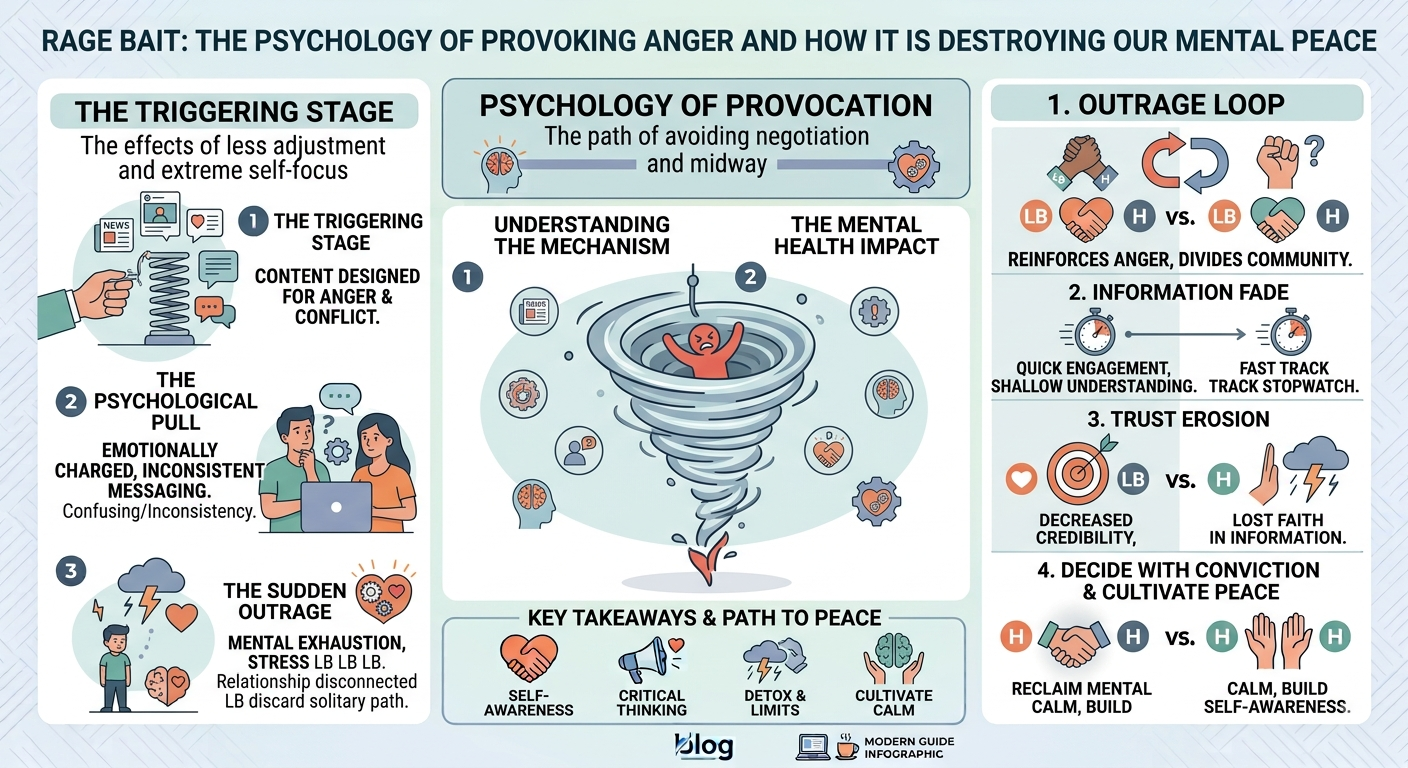
Rage bait is the deliberate act of saying, posting, sharing, or doing something provocative with the intention of making another person angry. The objective may be attention, entertainment, control, engagement, money, popularity, or simply the satisfaction of watching someone lose their composure. Although the expression is strongly associated with social media, the behaviour itself is much older. A student teasing a classmate until they explode, a colleague deliberately making a provocative remark during a meeting, or a family member repeatedly touching an emotional nerve can all be forms of rage baiting.
Understanding Rage Bait
The defining feature is intentional provocation. Not every disagreement, criticism, controversial opinion, or insensitive statement is rage bait. Rage bait exists when provocation becomes the strategy. The person knows—or reasonably expects—that a particular statement or action will trigger anger and deliberately uses it to obtain a reaction.
The term became especially prominent in the digital age because anger generates attention. Merriam-Webster defines rage bait as online content that is intentionally offensive or provocative and designed to provoke anger or outrage, often to gain attention or money. Cambridge similarly describes rage baiting as deliberately putting information, images, videos, or other material online to make people angry and encourage them to respond.
Dictionary Definition of Rage and Bait
To understand the expression, it helps to understand its two components. Merriam-Webster defines rage as violent or uncontrolled anger, while bait can mean trying to make someone angry through criticism or insults.
Put together, rage bait means using provocation as bait to catch another person’s emotional reaction.
That reaction is the reward.
A rage-baiter may not necessarily want to win an argument. They may not even care about the subject being discussed. What they want is the moment when the other person becomes visibly angry, defensive, embarrassed, frustrated, or emotionally overwhelmed.
In other words, the real conversation is often not about the topic. The topic is merely the trigger.
What Do Psychologists Say About Rage Bait?
Psychologically, rage bait works because anger is an activating emotion. When people become angry, they are more likely to pay attention, respond, defend themselves, search for information and communicate their reaction. Research on social-media outrage has found that virality itself can influence expressions of outrage, while emerging research on rage bait suggests that provocative content can exploit the way people decide what to click, watch and engage with.
Communication researchers have also pointed toward the incentive structure behind rage bait. Stanford’s discussion of rage bait describes a familiar formula: someone confidently presents something outrageous, offensive, absurd or deliberately extreme, often without nuance, to trigger an immediate emotional response.
This creates a psychological loop: provocation → anger → reaction → attention → reinforcement.
If the rage-baiter receives attention every time they provoke somebody, the behaviour can become reinforced. The person learns that pushing a particular button produces a predictable outcome. Over time, they may become increasingly skilled at identifying emotional vulnerabilities.
However, it would be inappropriate to diagnose every rage-baiter with a particular psychological disorder. Rage baiting is a behaviour, not a psychiatric diagnosis. People can engage in it for very different reasons, including insecurity, competitiveness, amusement, attention-seeking, desire for dominance, revenge, social-media growth or financial incentives.
Is There Any Law Against Rage Baiting?
There is an important distinction here: rage baiting itself is generally not a standalone offence merely because someone has annoyed or angered another person.
The legal question is what the person actually did.
For example, if someone posts false allegations that damage another person’s reputation, repeatedly threatens them, engages in unlawful harassment, publishes prohibited material, impersonates them, or uses digital communication for criminal intimidation, existing laws may become relevant.
In India, the Bharatiya Nyaya Sanhita (BNS), 2023 contains provisions concerning criminal intimidation and defamation. Section 351 addresses criminal intimidation, including threats intended to cause alarm, while Section 356 deals with defamation involving imputations intended or known to harm a person’s reputation.
Therefore, a person cannot necessarily defend themselves by saying, “I was only rage baiting.” If the underlying conduct crosses a legal boundary, the label does not provide immunity.
At the same time, an unpleasant opinion, sarcastic comment or provocative disagreement does not automatically become a crime. The exact facts, intent, content and applicable law matter. Anyone facing serious threats, harassment or reputational harm should seek advice from a qualified legal professional rather than assuming that every instance of rage bait has a legal remedy.
Rage Bait in Schools
Rage bait can begin surprisingly early.
Imagine a student who repeatedly tells another student, “You’re scared because you can’t answer,” knowing that the other child becomes embarrassed in front of classmates. The first student continues until the target loses their temper. Then the rage-baiter laughs and tells everyone, “Look how angry he gets!”
Another example could involve deliberately hiding someone’s belongings, making humiliating comments about their appearance, excluding them from a group and then recording their reaction.
The important point is that the provocation may be disguised as humour.
“Can’t you take a joke?” is sometimes used after deliberately provoking someone. But humour requires some degree of mutuality. When one person repeatedly enjoys another person’s distress, it can become bullying rather than harmless humour.
Schools therefore need to distinguish between ordinary teasing, disagreement, bullying and deliberate emotional provocation.
Rage Bait in College
College environments provide a larger social audience, which can make rage bait more rewarding.
A student may deliberately make an inflammatory statement during a group discussion because they know a particular classmate will react. Another may provoke someone in a hostel or college group and record the resulting confrontation for social media.
Sometimes the objective is social status.
The rage-baiter gets the reputation of being fearless, funny or “unfiltered”, while the person who reacts becomes labelled as sensitive or short-tempered.
This creates an unfair dynamic. The provocateur controls the trigger, while the target receives the blame for the reaction.
Rage Bait at the Workplace
Workplace rage bait can be considerably more damaging because professional relationships, reputation and career progression are involved.
Consider an employee who repeatedly makes subtle remarks about a colleague’s competence during meetings. When challenged, the person responds, “I was only asking a question.”
Another colleague may deliberately send an ambiguous email, wait for a reaction and then portray the recipient as aggressive when they respond emotionally.
A manager might repeatedly provoke an employee in front of colleagues because they know that the employee has a strong emotional response to public criticism.
Workplace rage bait is particularly dangerous because it can be hidden behind professional language.
The words may appear innocent individually, but the pattern tells a different story.
Repeated provocation, public embarrassment, selective criticism and deliberate emotional triggering can gradually create a hostile working environment. Employees should document serious incidents and use appropriate organisational grievance or HR channels when necessary.
Rage Bait on Social Media
Social media is perhaps the perfect environment for rage bait.
A creator posts an intentionally outrageous statement. People become angry. They comment. Others quote the post to criticise it. Someone creates a reaction video. Another person shares a screenshot. The original creator receives more views.
And the cycle continues.
Stanford researchers describe rage bait as a negative form of clickbait in which offensive or outrageous content encourages harsh responses and can be amplified by the engagement-driven architecture of social platforms.
The irony is powerful: people may hate the content while simultaneously helping it succeed.
A person who angrily comments, “This is absolutely ridiculous!” may believe they are opposing the creator. Algorithmically, however, that interaction may contribute to the visibility of the original content.
This is why one of the most powerful responses to rage bait is often surprisingly simple:
Don’t feed the bait.
Rage Bait in Personal and Family Relationships
Rage bait is not restricted to strangers.
It can exist inside intimate relationships.
A partner may deliberately bring up an old mistake because they know it will trigger an argument. A sibling may repeatedly compare you with another family member because they know you dislike the comparison. A parent, adult child or relative may use a particular personal insecurity during disagreements.
Sometimes the statement is followed by:
“You always overreact.”
That sentence can become part of the cycle.
The person provokes → the target reacts → the target is labelled emotional → the original provocation disappears from the conversation.
Healthy relationships allow disagreement, but they should not depend on repeatedly discovering someone’s emotional wounds and pressing them like buttons.
What Kind of Personality Engages in Rage Bait?
There is no single “rage-bait personality.” However, repeated rage baiting may be associated with certain behavioural tendencies.
Some individuals are attention seekers who enjoy becoming the centre of a conversation. Others are highly competitive and treat every interaction as a contest they must win. Some use provocation as a means of establishing dominance. Others enjoy watching emotional reactions because they find them entertaining.
There can also be people who are insecure but compensate through provocative behaviour. If they cannot obtain respect through competence or emotional maturity, they may obtain attention through conflict.
Social-media rage baiters may have an additional incentive: visibility and monetisation.
Consequently, it is important not to casually label a rage-baiter as a narcissist, psychopath or sociopath. Such labels require clinical assessment and should not be inferred merely from irritating behaviour.
Signs of a Repeat Rage-Baiter
A one-time provocative comment does not necessarily make someone a rage-baiter. A pattern is more revealing.
A repeated rage-baiter often knows exactly which subjects upset particular people. They may repeatedly return to the same sensitive topic. They may smile, laugh or appear unusually satisfied when the other person becomes angry. They may provoke and then deny responsibility by saying, “I was just joking.”
Another common sign is plausible deniability.
They say something deliberately provocative but maintain enough ambiguity to escape accountability.
They may also reverse the narrative after provoking someone: instead of discussing what they said, they focus entirely on the other person’s reaction.
A particularly concerning pattern is escalation. When a mild provocation stops producing a reaction, the person increases the intensity.
That is when rage bait can move from annoying behaviour into emotional harassment, bullying or abuse.
How Does Rage Bait Affect People?
The immediate effect is anger, but the consequences can extend much further.
Repeated exposure to provocation can create frustration, emotional exhaustion, anxiety, distrust and interpersonal conflict. A person may begin anticipating the next attack even before it happens. They may constantly monitor what they say because they fear that something will be deliberately twisted.
At a societal level, rage bait contributes to an environment where outrage becomes normal communication.
Instead of asking, “Is this true?”, people start asking, “How angry does this make me?”
That is a dangerous transition.
When outrage becomes the primary currency of public conversation, nuance becomes unattractive. Moderate positions receive less attention. Extreme statements travel faster. People become divided into camps, and disagreement starts looking like personal warfare.
The result is a society that may be highly connected digitally but increasingly exhausted emotionally.
How Should You Deal With a Rage-Baiter?
The first step is to identify the game.
Ask yourself: “Is this person trying to solve a problem, or are they trying to produce a reaction?”
If the second possibility appears more likely, reduce the emotional reward.
Do not immediately answer. Pause. Lower your voice. Avoid lengthy explanations. Do not provide an emotional monologue that gives the person more material to manipulate.
A calm sentence can sometimes be more powerful than a ten-minute argument:
“If you want to discuss the issue seriously, I’m willing to talk. If you’re trying to provoke me, I’m not participating.”
Then disengage.
Online, mute, restrict, block or report where appropriate. In workplaces, maintain professional communication and document serious patterns. In schools and colleges, involve teachers, administrators or appropriate authorities when behaviour becomes bullying or harassment.
When Should You Avoid Them?
Avoidance becomes especially appropriate when the person repeatedly violates boundaries and shows no willingness to change.
You do not have to prove your emotional strength by remaining in every argument.
There is a difference between running away from a disagreement and protecting yourself from unnecessary provocation.
If someone repeatedly insults you, deliberately humiliates you, threatens you, manipulates you, damages your reputation or deliberately escalates conflicts, creating distance can be healthier than repeatedly confronting them.
Sometimes the strongest response is not another argument.
It is reduced access to you.
Escape or Fight: Which Is Better?
The answer is neither always “escape” nor always “fight.”
The better approach is strategic disengagement.
Fight when an important boundary, safety issue, professional responsibility or legitimate right requires a response. But fighting does not necessarily mean shouting back. It can mean documenting evidence, reporting misconduct, establishing a boundary, correcting misinformation or seeking formal intervention.
Escape when the conflict has no meaningful benefit and the other person is clearly seeking only emotional entertainment.
Think of it this way:
Respond to the problem, not the provocation.
If someone throws emotional bait and you immediately bite, they control the conversation.
If you calmly decide whether the underlying issue deserves your attention, you regain control.
How Much Should We Tolerate?
Very little when the behaviour becomes repetitive and intentional.
Everyone occasionally makes an insensitive comment. People lose their temper. Friends tease one another. Colleagues misunderstand each other. Families argue.
Human relationships require some tolerance.
But tolerance should not become permission.
A useful distinction is between mistake and pattern.
A mistake followed by genuine accountability deserves understanding.
A repeated behaviour followed by “You are too sensitive” deserves a boundary.
If someone repeatedly hurts you, provokes you and then blames you for reacting, the issue is no longer merely your emotional sensitivity. The interaction itself needs examination.
How Rage Bait Is Affecting Society’s Mental Peace
The larger problem is that rage bait is turning emotional disturbance into a form of entertainment.
We increasingly encounter content designed not to inform us but to activate us.
A calm article may receive limited attention. A deliberately insulting statement may generate thousands of comments. A thoughtful disagreement may disappear while an outrageous claim becomes viral.
This creates an incentive structure where peace is boring and outrage is profitable.
The responsibility therefore does not belong exclusively to content creators. Audiences also have power.
Every click, comment, share and angry reaction can become a vote for the type of content we want to see more often.
If we constantly reward outrage, outrage will multiply.
If we learn to recognise manipulation and selectively withdraw our attention, the incentive weakens.
Conclusion: Don’t Let Someone Else Hold Your Emotional Remote
Rage bait ultimately depends on one thing: your reaction.
The rage-baiter may throw the stone, but the emotional explosion occurs inside the target. Learning to recognise the pattern gives you an opportunity to interrupt it.
You do not have to answer every insult. You do not have to defend yourself against every provocative statement. You do not have to win every argument. And you certainly do not have to allow another person to repeatedly discover your emotional buttons and press them for entertainment.
The mature response is not always silence, and it is not always confrontation.
It is choice.
Know when to respond. Know when to establish a boundary. Know when to document and report. And know when to walk away.
Because the ultimate victory over rage bait is not making the other person angry.
It is refusing to let them control your peace.
Reply here