
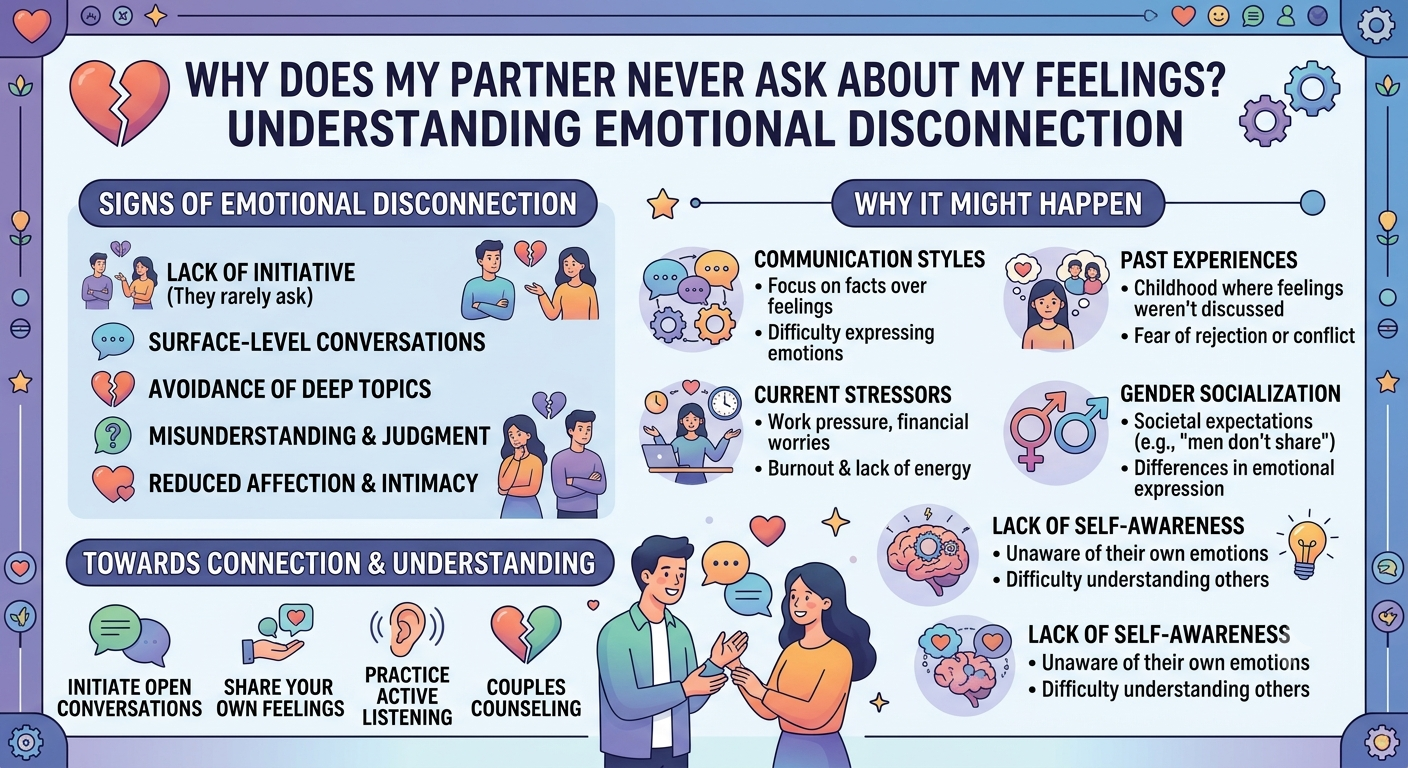
Have you ever had a difficult day, felt emotionally exhausted, or struggled with something important, only to realise that your partner never asked, “How are you feeling?” Perhaps they ask about your work, dinner, or daily responsibilities but rarely show curiosity about what is happening inside your heart.
Over time, this can leave you feeling lonely, even when you are in a relationship.
You might wonder, “Does my partner really care about me?” or “Why am I always the one trying to start an emotional conversation?”
If these thoughts sound familiar, you are not alone. Many couples experience emotional disconnection, where they continue sharing their lives but gradually stop sharing their feelings.
Understanding why this happens can help you rebuild emotional intimacy and create a relationship where both partners feel heard, valued, and understood.
1. What Does It Mean When Your Partner Never Asks About Your Feelings?
Emotional connection is more than spending time together, sharing responsibilities, or saying “I love you.”
It involves feeling safe enough to express your emotions and knowing that your partner genuinely wants to understand them.
When your partner rarely asks about your feelings, you may experience:
- Feeling emotionally neglected despite being together.
- Hesitation to share personal struggles.
- Frustration when your partner does not notice your emotional needs.
- Loneliness during difficult moments.
- A growing sense that your relationship lacks emotional depth.
For example, imagine you had a stressful day at work. You come home hoping your partner will notice your mood and ask what happened. Instead, they continue discussing household responsibilities.
Although they may not intend to hurt you, their lack of emotional attention can make you feel invisible.
This is often where emotional disconnection begins.
2. Why Does My Partner Avoid Emotional Conversations?
There is rarely one single explanation for why someone does not ask about their partner’s feelings. Understanding the possible reasons can help you approach the situation with curiosity rather than blame.
They Were Never Taught to Express Emotions
Some people grow up in families where emotional conversations are uncommon. They may have learned that expressing sadness, fear, or vulnerability is unnecessary or uncomfortable.
As adults, they might struggle to ask emotional questions simply because they never learned how to do so.
They Show Love Through Actions
Your partner may believe that providing financial support, helping with household responsibilities, or spending time together is enough to demonstrate love.
Their intentions may be genuine, but their way of expressing affection might differ from yours.
You may need emotional reassurance, while they may focus on practical support.
They Feel Uncomfortable With Vulnerability
Emotional conversations can make some people feel exposed. They may worry about saying the wrong thing, being unable to solve your problems, or becoming overwhelmed by difficult emotions.
Instead of asking questions, they may change the subject or offer quick solutions.
They Are Emotionally Overwhelmed
Work pressure, personal stress, and unresolved relationship conflicts can affect someone’s ability to remain emotionally present.
However, understanding your partner’s difficulties does not mean ignoring your own emotional needs.
Both partners deserve care and consideration.
3. How Emotional Disconnection Affects Your Relationship
When emotional needs remain unmet for a long time, the relationship may begin to feel distant.
You might stop sharing your experiences because you expect your partner to be uninterested. Eventually, even small conversations may feel meaningless.
This can create a painful cycle:
You feel disconnected → You stop sharing → Your partner becomes less aware of your feelings → You feel even more disconnected.
Over time, emotional distance can affect trust, affection, communication, and relationship satisfaction.
The difficult part is that couples may continue functioning perfectly well on the outside while feeling emotionally alone within the relationship.
A relationship can have regular communication without having meaningful emotional connection.
The difference lies in whether both partners feel genuinely understood.
4. How to Tell Your Partner That You Need Emotional Attention
If you are wondering how to communicate your emotional needs, begin with a calm and honest conversation.
Avoid starting with accusations such as, “You never care about me” or “You don’t understand anything.”
Instead, explain what you experience and what would help you feel closer.
For example:
“I know you care about me, but sometimes I feel emotionally disconnected when we don’t talk about how we are feeling. When I have a difficult day, it would mean a lot if you asked me what happened or how I am doing.”
You can also try these small steps:
- Be specific: Explain the situations in which you feel emotionally neglected.
- Express your needs: Tell your partner what emotional support looks like for you.
- Ask about their experience: Understand whether emotional conversations feel difficult for them.
- Create small rituals: Spend 10 minutes each day discussing how you both feel.
- Appreciate their efforts: Recognise genuine attempts to become more emotionally available.
Remember, emotional intimacy is not built through one perfect conversation. It develops through consistent, everyday efforts.
5. When Should You Consider Relationship Counselling?
Sometimes, couples understand the importance of emotional connection but struggle to create it.
Repeated arguments, communication gaps, unresolved resentment, or differences in emotional expression can make it difficult to move forward independently.
This is where relationship counselling can help.
A counsellor can provide a neutral space where both partners can express their concerns without feeling judged.
Through counselling, couples can learn to:
- Identify unmet emotional needs.
- Understand different communication styles.
- Express feelings without blame.
- Develop healthier listening habits.
- Rebuild emotional trust and intimacy.
Seeking counselling does not necessarily mean your relationship is failing. It can simply mean that you want to understand each other better.
At Counselling Deck, we believe every relationship deserves an unbiased and personalised approach. Sometimes, having the right conversation with the right guidance can help couples discover what they have been missing.
Conclusion: Emotional Connection Begins With Feeling Seen
If your partner never asks about your feelings, it is natural to feel hurt, confused, or emotionally distant.
However, their behaviour does not automatically mean they do not love you. It may reflect differences in communication, emotional awareness, or unresolved relationship patterns.
What matters is whether both partners are willing to understand each other and make an effort.
You deserve a relationship where your feelings are not treated as an inconvenience but as an important part of who you are.
Love is not only about being together. It is also about being emotionally present for each other.
And sometimes, the simplest question can make the biggest difference:
“How are you really feeling today?”
Reply here