
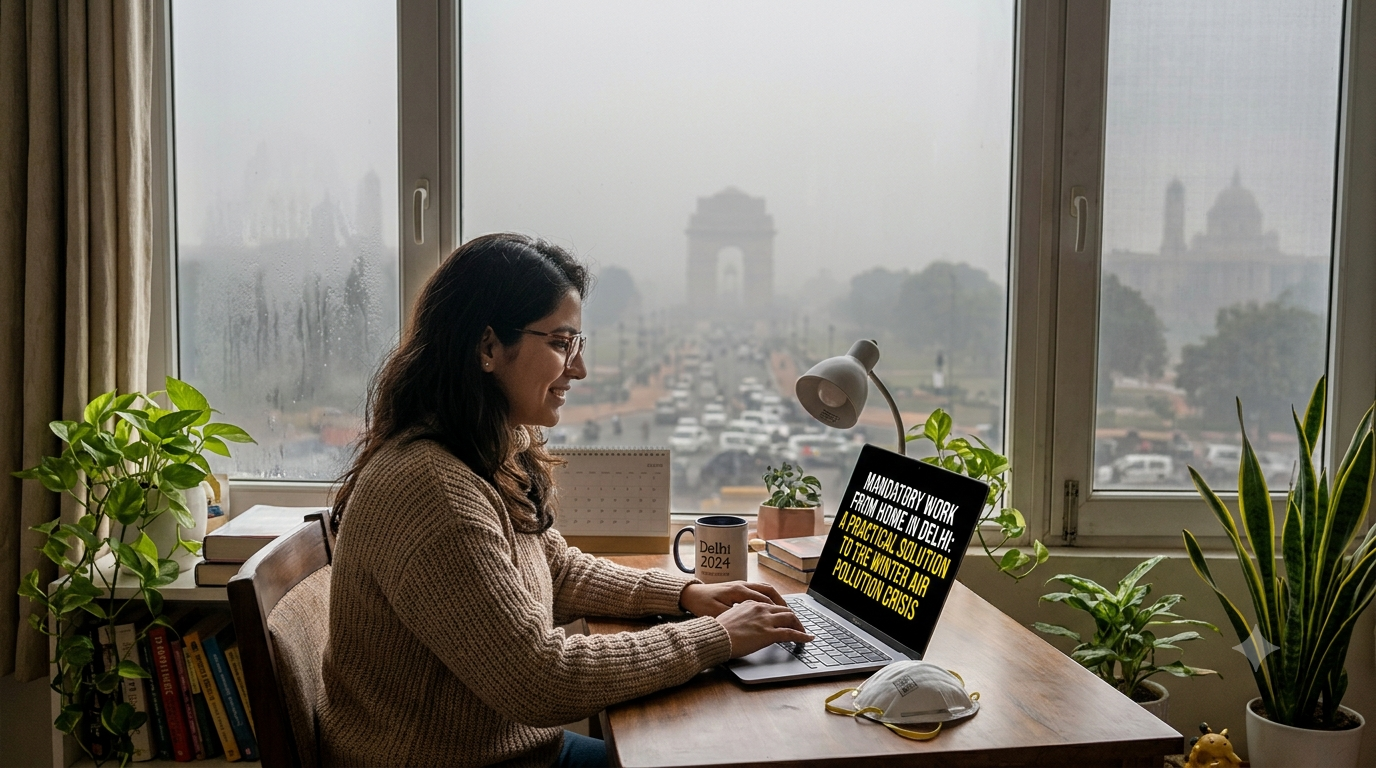
Why Delhi should adopt a five-month Work From Home policy to protect public health, reduce pollution, conserve resources, and create opportunities beyond metropolitan cities.
Every winter, Delhi faces a recurring environmental crisis. The air becomes difficult to breathe, visibility deteriorates, and millions of residents are exposed to dangerously high levels of air pollution. While governments introduce several emergency measures to control pollution, one practical solution deserves greater attention: Mandatory Work From Home (WFH) for desk-based employees across Delhi NCR from October to February every year.
Delhi’s pollution crisis is not merely an environmental issue. It is a public health emergency that affects our elderly population, children, working professionals, and families. If technology allows millions of employees to perform their jobs remotely, why should they be compelled to commute through an already polluted city during its most vulnerable months?
It is time to reconsider our traditional approach to office attendance and explore WFH as a structured seasonal pollution-control policy.
1. What Published Research Says About Work From Home
The Centre for Policy Research (CPR), in its research paper Work from Home – How Good is it for the Environment?, examined the potential environmental impact of remote working, including an illustrative analysis for Delhi.
The study suggests that WFH can reduce commuting-related energy consumption and emissions, although its overall environmental benefits depend on several factors, including household energy use and commuting patterns.
Based on a proportional five-month calculation of the annual estimates presented in the research, the potential October–February impact could include:
- 542 million to 2.125 billion vehicle kilometres avoided.
- Approximately 24 to 95 tonnes of PM2.5 emissions avoided.
These figures are illustrative estimates, not guaranteed reductions. Nevertheless, they demonstrate the potential of reducing unnecessary commuting on a large scale.
Furthermore, the Commission for Air Quality Management (CAQM) has identified transport as a significant contributor to winter PM2.5 pollution in Delhi NCR, accounting for approximately 23% of winter PM2.5 in the cited source-apportionment analysis.
When transportation contributes substantially to winter pollution, reducing avoidable daily commuting should be considered an important part of the solution.
Research references:
- CPR Research Paper: Work From Home – How Good Is It for the Environment?
- CAQM Winter Air Pollution Analysis
2. Why Delhi Needs a Seasonal WFH Policy
The benefits of WFH extend far beyond reducing vehicle emissions.
Protecting the Health of Elderly Citizens
Older people are particularly vulnerable to respiratory complications caused by polluted air. Reducing traffic emissions and unnecessary outdoor exposure can contribute to a healthier environment for elderly citizens.
Conserving Electricity and Fuel
Large office buildings consume electricity for lighting, heating, cooling, and other operations. A well-designed WFH policy could reduce office energy consumption.
Similarly, fewer daily commutes could mean lower petrol and diesel consumption, reducing the financial burden on households and dependence on conventional fuels.
However, electricity savings must be evaluated against additional household energy consumption.
Reducing Traffic Congestion and Road Accidents
Delhi’s roads experience significant congestion during office hours. Fewer commuting vehicles could improve traffic flow, reduce travel time, and potentially lower the risk of road accidents.
Winter visibility challenges make reducing unnecessary road traffic even more relevant.
Creating Opportunities in Smaller Cities
A seasonal WFH policy could encourage employees to work from their hometowns, Tier 3 and Tier 4 cities, and rural areas.
This could stimulate local economies, expand demand for digital services, and create new opportunities for businesses outside metropolitan centres.
Instead of concentrating employment opportunities in Delhi NCR, remote working could help distribute economic activity more evenly.
Supporting Family Stability and Mental Well-being
WFH can provide employees with more opportunities to spend time with their families, support elderly parents, and maintain meaningful social connections.
It could also benefit dual-income, single-child households by reducing commuting pressure and improving work-life balance.
With appropriate boundaries between work and personal life, remote working may support mental well-being and stronger family relationships.
Boosting Tourism and Local Economies
Employees could temporarily relocate to their hometowns or other destinations during the winter months, provided their employers permit it.
This could support domestic tourism, local hospitality businesses, and regional economic development.
3. A Practical Policy for Delhi Government
The Government of Delhi should consider a structured five-month WFH policy, coordinated with neighbouring NCR states and CAQM.
The objective should not be to disrupt businesses but to eliminate unnecessary commuting wherever technology already enables employees to work remotely.
A. Mandatory WFH for Desk-Based Jobs
From October to February, WFH should be mandatory for employees whose responsibilities can be performed remotely without compromising productivity or service delivery.
The policy should cover:
- IT and software companies.
- Banks and financial institutions.
- Corporate and administrative offices.
- HR, accounts, and finance departments.
- Customer support and call centres.
- Marketing, sales operations, and consultancy firms.
- Other digitally enabled desk-based occupations.
B. Clearly Defined Exemptions
The policy should not apply to occupations that require physical presence.
These should include:
- Factory workers engaged in production-line activities.
- Manual labourers involved in physical production.
- Essential and emergency services.
- Public health services.
- Educational services.
Organisations should be allowed to identify additional operational requirements through clearly defined exemption criteria.
C. NCR-Wide Implementation
Air pollution does not recognise administrative boundaries.
A policy implemented only in Delhi could lead to employees continuing to commute from Gurugram, Noida, Ghaziabad, and Faridabad.
Therefore, Delhi should initiate consultations with Haryana, Uttar Pradesh, and the relevant NCR authorities to establish a coordinated seasonal WFH framework.
CAQM could facilitate regional coordination, monitoring, and implementation.
4. Start With a 90-Day Pilot Programme
Before implementing a permanent five-month mandate, the government should consider a 90-day pilot programme.
The pilot should measure:
| Indicator | What Should Be Measured |
|---|---|
| Vehicle movement | Reduction in daily commuting vehicles |
| Fuel consumption | Petrol and diesel consumption avoided |
| Emissions | Transport-related PM2.5 and NOx reductions |
| Electricity | Changes in office electricity consumption |
| Traffic | Changes in congestion and travel time |
| Air quality | Changes in ambient pollution levels |
The results should be independently evaluated to determine the policy’s actual environmental, economic, and social impact.
The government could subsequently refine the policy based on evidence and expand its implementation across Delhi NCR.
5. Delhi Has an Opportunity to Lead India
Delhi has already demonstrated that technology can transform how people work. The pandemic proved that many desk-based jobs can be performed remotely without requiring employees to travel to an office every day.
The question is no longer whether WFH is possible.
The question is whether we are willing to use it strategically to address one of the most serious environmental challenges facing our capital.
Mandatory WFH should not be viewed merely as an employee convenience or an emergency arrangement. It should be evaluated as a structured seasonal pollution-control measure.
We are investing considerable resources in temporary pollution-control measures. Alongside these interventions, we should also examine opportunities to eliminate unnecessary daily commuting wherever technology permits.
If an employee can perform the same work from home without compromising productivity, why should that employee be required to travel through an already polluted city during its most vulnerable months?
A coordinated five-month WFH policy could help Delhi reduce avoidable emissions, conserve fuel, improve traffic conditions, support families, and create economic opportunities beyond metropolitan cities.
The air we breathe is a shared responsibility. The solutions we adopt must reflect the scale of the problem.
I respectfully urge the Hon’ble Chief Minister of Delhi and the concerned authorities to initiate consultations with CAQM and neighbouring NCR state governments to examine the feasibility of mandatory seasonal WFH for desk-based employees.
Delhi deserves a future where economic growth and environmental protection go hand in hand.
Perhaps the most practical way to reduce the number of vehicles on Delhi’s roads this winter is not to build another road, but to allow millions of people to work without travelling on one.
Reply here